

AI Marketing For Local Businesses: What Actually Works (And What's Just Noise)


If you run a local business, you've been pitched AI marketing about four hundred times in the last twelve months.
AI ad copy. AI websites. AI lead nurture. AI content. AI chatbots. AI image generation. AI everything.
Some of it is real. A lot of it is not. The hard part is knowing the difference, because the people selling it are usually not the people who know how to tell.
This is the honest version. Where AI is actually pulling weight for small local businesses in 2026, where it's flat-out hurting them, and where it's just expensive noise.
The baseline: what AI is, and what it isn't.
AI marketing tools are not magic. They're prediction engines trained on enormous amounts of text, images, and patterns. They generate output that looks like what humans tend to make, based on the patterns they've seen.
That means they're great at three things: generating volume fast, recognizing patterns, and doing repetitive tasks at scale.
They're bad at three other things: original thought, judgment about your specific business, and understanding what makes a real human in your neighborhood actually pick up the phone.
The trick isn't whether to use AI. It's knowing which tasks are AI's strength and which tasks still need a human in the seat.
Where AI actually helps local businesses right now.
A few use cases are clearly worth the time.
First drafts of written content. Email newsletters, social captions, blog post outlines, product descriptions. AI can move a first draft from blank page to 70% done in minutes. The 70% saves real hours. The remaining 30% - the personality, the local references, the actual hook - still has to come from a human who knows the business.
Image generation for content and ads. Tools like Midjourney can produce strong visual assets, stock-style imagery, and creative concepts that would have cost hundreds of dollars and a week of designer time two years ago. Used correctly, this is a serious unlock for small businesses without a creative budget.
Customer service triage. Chatbots that handle the first wave of common questions - hours, location, pricing, scheduling - free up real humans to handle the conversations that actually need them. Good local businesses use these to qualify leads, not replace people.
Data and competitive analysis. AI tools can read through dozens of competitor websites, identify gaps, summarize reviews, and surface patterns that would take a human a full day. For a business owner trying to figure out where they sit in their market, this is genuinely useful.
Personalization at scale. Email subject lines tailored to the recipient. Product recommendations based on past behavior. Audience segmentation. Things that used to require a marketing department now happen in the background.
The pattern across all of these: AI handles the volume. The human handles the judgment.
Where AI is actively hurting local businesses.
Now the other side.
AI-generated content that has no business being published. The hallmarks are everywhere now - the same predictable phrases, the same patronizing tone, the same generic structures. "In today's fast-paced world..." "Let's dive in..." "It's worth noting..." Buyers can spot AI content from across the room, and once they spot it, they assume the business is lazy. The damage to trust is real and lasting.
Full AI-generated marketing campaigns. A campaign written, designed, and deployed by AI with no human in the loop reads exactly like what it is - empty. The phrases are right. The structure is right. The soul is missing. Customers feel it even when they can't name it. The conversion rates on these campaigns are usually a fraction of what a halfway decent human-built campaign produces.
AI chatbots that try to do too much. The line between "first wave triage" and "automated relationship killer" is thin. Local businesses that hide a real person behind seven layers of AI prompts lose customers the moment a real question comes up. Customers will tolerate AI for the easy stuff. They will not tolerate AI for the moment they actually need help.
"AI strategy" services that are mostly markup. A lot of marketing companies in 2026 are charging premium rates to do what amounts to running ChatGPT prompts. The output is generic. The client is paying for what they could do themselves in twenty minutes. Knowing this saves a lot of money.
Auto-posted social content. Schedule-and-forget AI content tools produce the kind of feed that signals "this business doesn't really care." Empty engagement. Generic captions. Nothing local, nothing real. Worse than not posting at all.
The common thread: anywhere AI replaces the human relationship rather than supporting it, the business pays for it eventually.
The "AI slop" problem.
There's a term that's emerged for the worst version of AI output: slop.
Slop is AI content that's been generated, lightly edited or not edited at all, and pushed live as if it were finished work. It's images that almost look right but have weird artifacts. It's writing that's grammatically perfect and emotionally hollow. It's videos with the same five stock-feeling cuts and the same robot narration.
The internet is filling up with it. Customers are getting better at spotting it. And the businesses producing it are quietly losing trust without realizing why.
The opposite of slop isn't "no AI." The opposite is intentional AI - using the tools to accelerate human work, not replace it. The businesses doing this well still feel like real businesses run by real people. The ones doing it poorly feel like a bot wearing a logo.
A simple framework for local businesses thinking about AI.
Three questions worth asking before adopting any AI tool.
Does this free up time for the work only a human can do? If yes, it's probably worth using. If it just replaces a human task with an AI version of the same task without freeing anyone up, the math usually doesn't work.
Will the customer be able to tell? If the answer is "no" and you're confident about that, you're using it correctly. If the answer is "yes," you're probably damaging trust without knowing it.
Would you be embarrassed if a competitor saw exactly how it was made? Good gut check. AI used well is invisible. AI used poorly leaves fingerprints everywhere.
A local business that uses AI to write better first drafts, design faster images, and triage incoming questions - while keeping a real human in every important conversation - is going to outperform two kinds of businesses simultaneously: the ones who refuse to use AI at all, and the ones who use AI for everything.
The middle path is the winning path.
What to actually do this month.
For local business owners trying to navigate this practically:
Pick two or three AI tools and learn them well. Don't try to use everything. A solid writing tool, a solid image tool, and maybe a scheduling or analysis tool is plenty.
Use them as a first-draft engine, not a final-draft engine. Every piece of content that goes out should have human judgment applied to it before it's published.
Keep the human moments human. Customer service that matters, sales conversations, complaints, anything emotional. Do not automate the moments that decide whether a customer becomes a customer for life.
Audit your current AI use. Look at what you've published in the last 90 days. If you can spot the AI fingerprints from a paragraph in, your customers can too. Fix the obvious slop first.
AI is a power tool. It is not the carpenter.
Local businesses that use it well are saving real time, producing more, and competing with much bigger operations.
Local businesses that lean on it too hard are quietly losing trust with the customers they need most.
The line between those two is human judgment. That part isn't going away.


Leave a comment
Comments will be approved before showing up.
Also in Marketing Tips
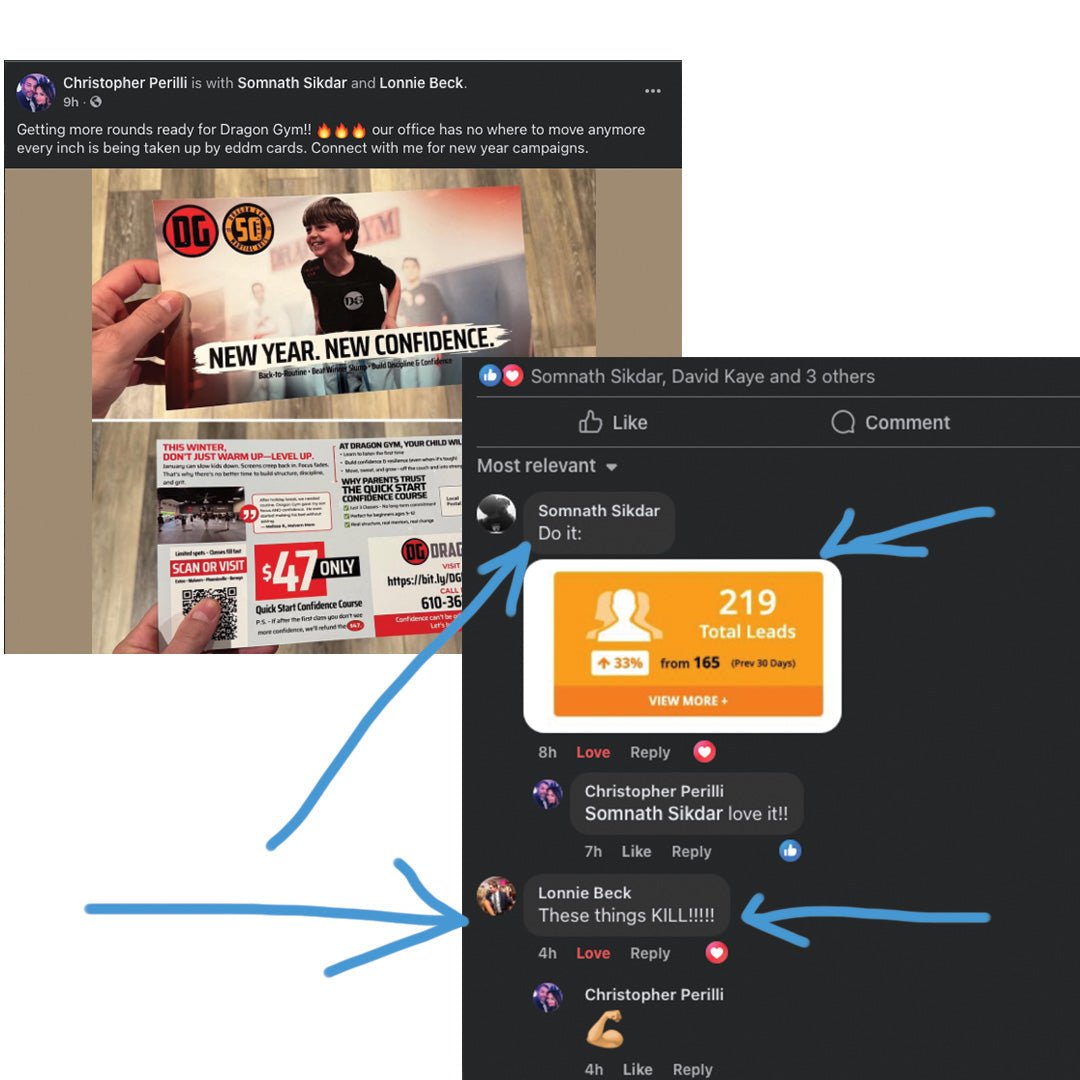

The First Card Doesn't Sell. The Third One Does.
Most schools mail one postcard, get little, and decide direct mail is dead. The real lever is frequency. Here is why the third touch converts, the honest math on reach versus repetition, and a three-drop holiday-to-January plan that fills your mat.
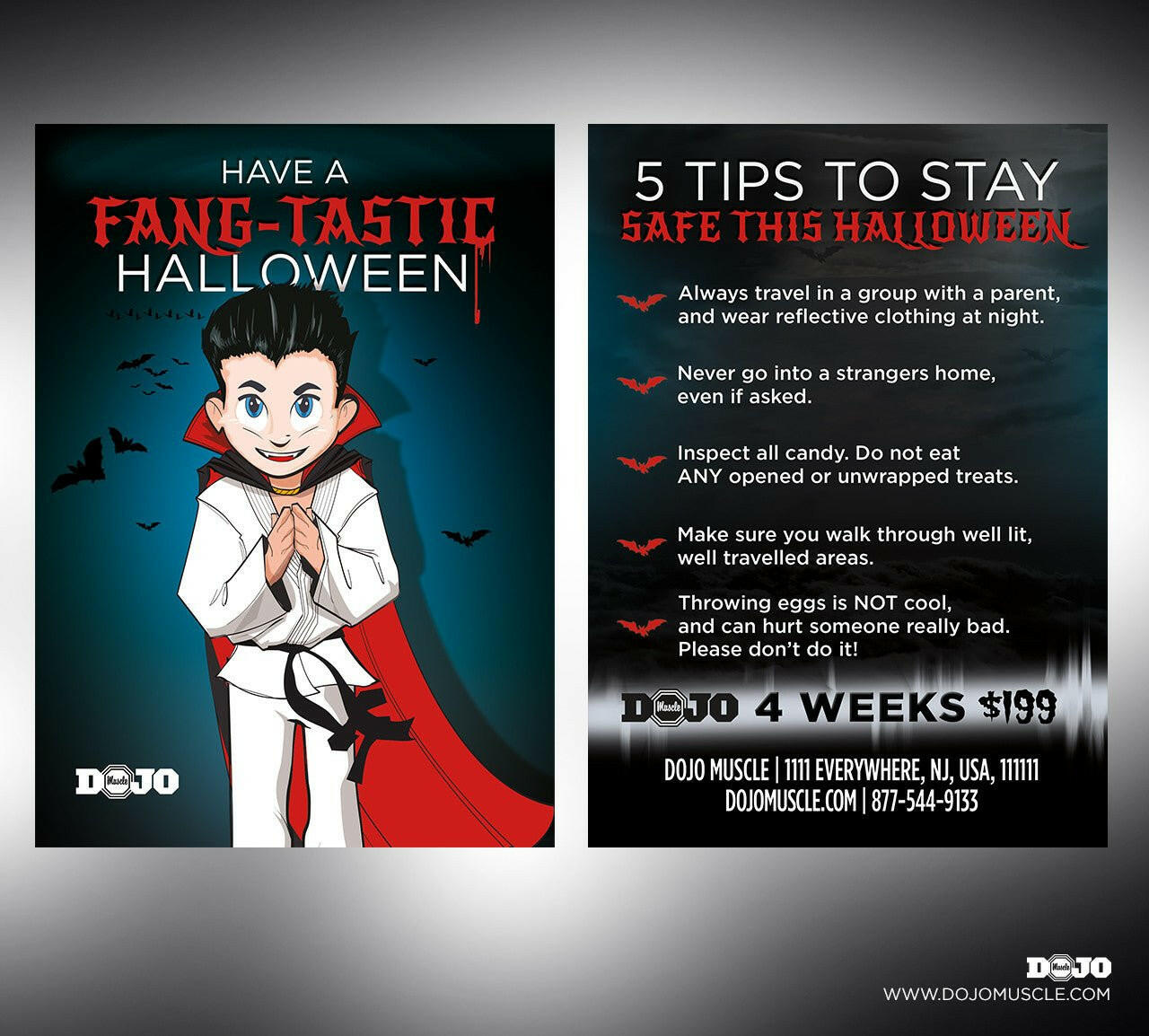

On Halloween The Whole Town Is Outside. Be Everywhere They Look.
Halloween is the one night your whole town is walking your neighborhood. Here's how to surround the same families in three places - the mailbox, the doorstep, and your storefront - with cards that give value instead of dying in a candy bucket, plus what to send by when.
Read More
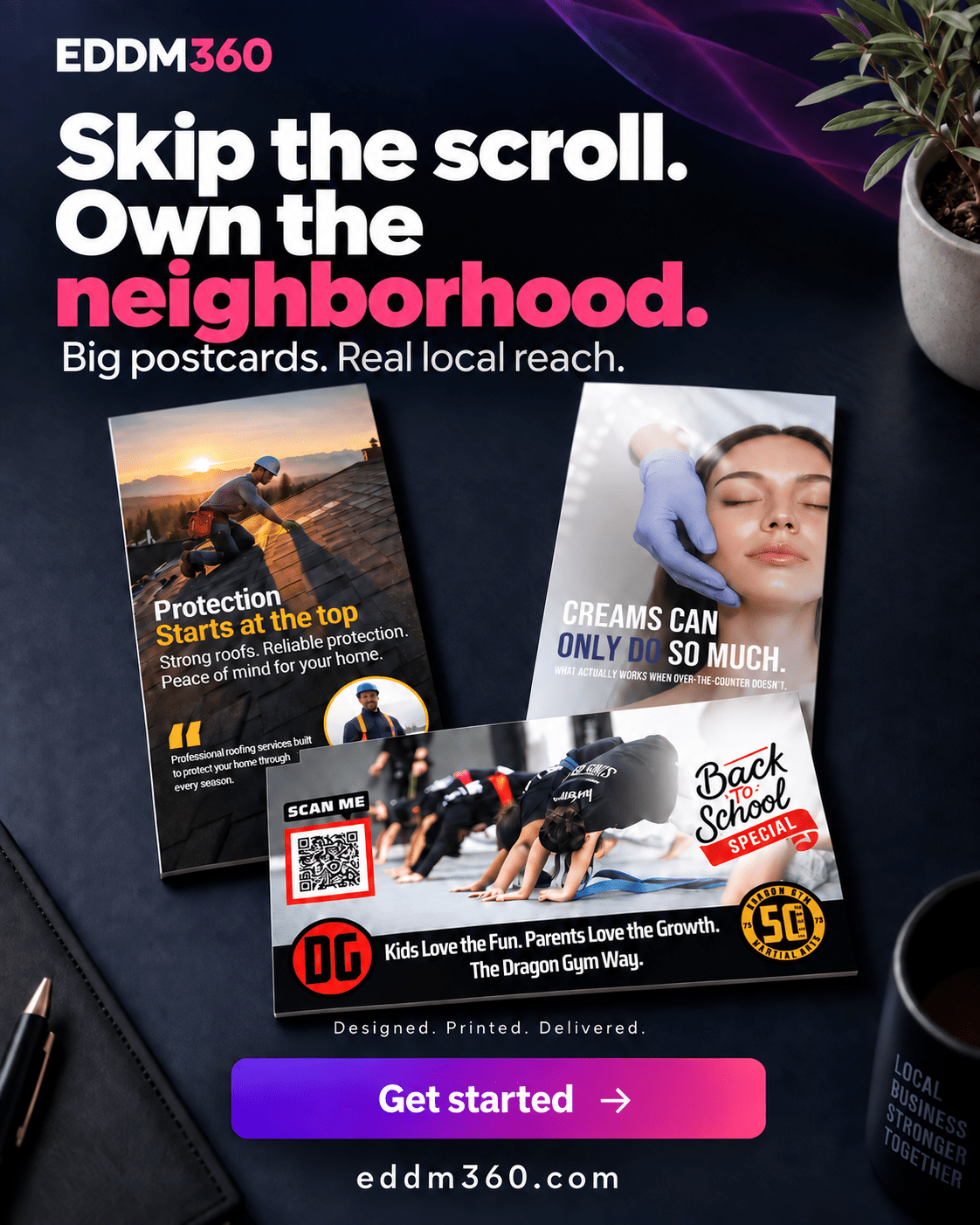

Most Of Your Town Has No Idea You Exist. That Changes Now.
EDDM 360 just got its own site at eddm360.com. Here's why one postcard never works, how three drops to the same homes builds trust, how a QR dashboard finally lets you track mail, and how to start with a free route scan.
Read More